“Can You Just Do This Little Thing for Me?”
And because it is small, and because it is a friend, you say yes.
Again.
You know how this goes. The request arrives casually, wrapped in the warmth of friendship and the assumption that because you are close, because you care about each other, because you would do anything for this person in a genuine emergency, surely this small thing is not too much to ask.
And it is small. Each individual request genuinely is small.
But you have been saying yes to small things for long enough to know that small things accumulate. That the occasional favour becomes the expected service. That the generous exception becomes the standing arrangement. That somewhere between the first yes and the twentieth, what you do for a living started feeling, to the people closest to you, like something they have a right to access for free.
Not because they are bad people. Not because the friendship is not real.
But because you made it easy to ask. And easy to ask always becomes easier to keep asking.
If that pattern feels familiar, this post is for you. You will learn here how to stop giving free work to friends.
Why Friends Feel Entitled to Free Work From Your Small Business
It did not start as entitlement. It started as closeness.
The first time a friend asked you to do something related to your work as a favour, it probably felt natural. You wanted to help. You had the skills. The relationship mattered more than the money. So you said yes, genuinely and without resentment, and it felt good to use what you had built for someone you loved.
But something happened after that first yes.
Your friend experienced your work and it was good. Of course it was. And the next time they needed something similar, they thought of you. Not of hiring someone. Of you. Because you had already established, through that first generous yes, that this was something friends did for each other.
And you said yes again. Because the friendship still mattered more than the money. Because saying no to someone you love felt harder than absorbing the cost. Because the request was still small enough to justify.
Research on friendship and financial boundaries consistently shows that the closer the relationship, the harder both parties find it to introduce clear financial limits, with women in particular reporting significantly higher levels of guilt when charging friends for professional services. Not because they mean harm. But because you made it easy to ask. And easy becomes easier over time.
Until the expectation calcifies. Until the asking stops feeling like a request and starts feeling like a right. Until you find yourself doing work for free for the people closest to you while charging strangers fairly. And the dissonance of that, the quiet wrongness of it, starts to cost you more than the time and the money.
What You Actually Built and Why It Has Value
Here is what most women with small businesses need to hear clearly and without qualification.
What you do is your work. Your time. Your energy. Your livelihood.
You built it. Through years of learning and practising and failing and improving and showing up consistently in a way that most people around you never see because the visible part is just the thing you produce, not the entire infrastructure of skill and effort and ongoing investment that makes the thing possible.
That infrastructure has value. Real, concrete, financial value. Value that exists regardless of who is asking for access to it.
When a stranger wants what you do, they pay for it without question. They understand that your time and your skill have a cost. They do not expect you to absorb that cost on their behalf simply because they would enjoy the result.
But when a friend wants what you do, something shifts. The transaction disappears. The professional relationship collapses into the personal one. And suddenly the cost that a stranger would pay without blinking becomes something you are expected to waive because of the closeness between you.
This is not fair. It is not kind. And it is not what friendship actually requires.
Friendship requires loyalty, care, presence, honesty and love. It does not require unlimited access to your professional skills at no cost to the person receiving them.
What Giving Free Work to Friends Actually Costs You
The individual favour seems small. An hour of your time. A quick job. Nothing dramatic.
But the pattern has a cost that the individual favour conceals.
It devalues your work in your own mind. Every time you give away what you would charge a stranger for, you send yourself a message about the worth of what you do. That message, repeated enough times, starts to feel like a truth. And a woman who does not fully believe in the value of what she built finds it harder to charge for it, harder to grow it, and harder to protect it.
It builds resentment that damages the friendship. The yes that comes from guilt rather than genuine generosity carries a cost. It produces a low-level resentment, quiet and uncomfortable, that accumulates over time. And resentment, left unnamed and unaddressed, gradually changes the quality of even the warmest friendship.
It attracts more of the same. When you say yes to free work for one friend, word travels in the way that word always travels in close social circles. And suddenly you find yourself fielding requests from people who heard that you helped someone else and assumed the same arrangement extended to them.
It takes time from paying work. The hours you spend giving free work to friends are hours you do not spend on clients who pay you. That is not a small cost. Over the course of a month, or a year, it compounds into something significant.
It teaches people that your no is not real. When you always eventually say yes, the people around you learn that asking enough times, or framing the request the right way, or leaning on the friendship hard enough, produces the result they want. Your yes stops meaning generosity and starts meaning inevitability.
Why Valuing Your Work Does Not Make You Less Kind
This is the belief at the centre of the pattern. And it is worth examining directly.
Most women who give free work to friends believe, on some level, that charging them would signal that the money matters more than the relationship. That putting a price on what they do for someone they love introduces a coldness that friendship should not have. That a good friend, a generous friend, a truly loving friend, would not let money come between them and the people who matter.
This belief is understandable. And it is wrong.
Valuing your work does not make you less kind. It makes you clear. It makes you sustainable. It makes the friendship more honest rather than less, because it removes the hidden transaction, the one where you give and give and give while quietly absorbing a cost that the other person never sees.
The kindest thing you can do for a friendship that involves your professional skills is to be clear about what those skills cost. Not because the friendship does not matter. But because a friendship built on an arrangement where you consistently give more than you receive, where you absorb a real cost while they receive a real benefit, is not as equal as it feels from the outside.
You can love someone completely and still charge them fairly. These two things do not contradict each other. They make the relationship more honest. More mutual. More real.
5 Ways to Stop Giving Free Work to Friends
You do not need a dramatic confrontation. You need a clear, warm shift in how you respond to requests.
1. Name your rate before they ask you to waive it. When a friend mentions needing something you do professionally, state your rate naturally and early. “I charge this for that kind of work. Let me know if you would like to book something in.” Matter of fact. Warm. Not an apology and not a negotiation opener. Just information.
2. Separate the friendship from the professional relationship. You can be a wonderful friend and a professional service provider to the same person. These are not in conflict. But they need to stay distinct. The friendship does not include professional services at no cost. The professional relationship operates at your standard rates. Both can exist simultaneously.
3. Offer a friendship discount if you choose to, not because you feel obligated. There is a difference between choosing to offer someone you love a reduced rate as a genuine act of generosity and reducing your rate because the guilt of charging them feels unbearable. One comes from abundance. The other comes from obligation. Only the first is worth doing.
4. Practise the warm but clear response. “I would love to help you with that. My rate for that kind of work is this. Want me to send you the details?” Said warmly, said clearly, said without apology. Not a negotiation. Not a request for their approval. Just a straightforward professional response to a professional request.
One More Way to Stop Giving Free Work to Friends
5. Let the discomfort sit without reversing your decision. The first time you charge a friend, or decline to give free work, the discomfort will arrive. Theirs and yours. Let it sit. Do not rush to fill the silence with an offer to do it for free after all. The discomfort passes. The new normal takes its place. And most friendships, the real ones, survive it without damage.
Clarity Is Not Coldness
There is a version of your professional life where the people closest to you understand and respect the value of what you built.
Where a friend who wants your services either pays your rate or genuinely and graciously accepts that this is not something you offer for free. Where the friendship does not depend on your willingness to absorb costs on their behalf. Where you give your work as a genuine gift on the occasions you freely choose to, not as a default response to every request that arrives wrapped in closeness.
That version does not require you to become harder or colder or less loving.
It requires you to become clearer.
Clear about what your work is worth. Clear about what friendship does and does not include. Clear about the difference between genuine generosity and guilt-driven compliance.
Friendship does not mean unlimited access to what you built. And valuing your work does not make you less kind.
It just makes you clear.
Your Next Step — 30 Days to Stop Giving Free Work Away
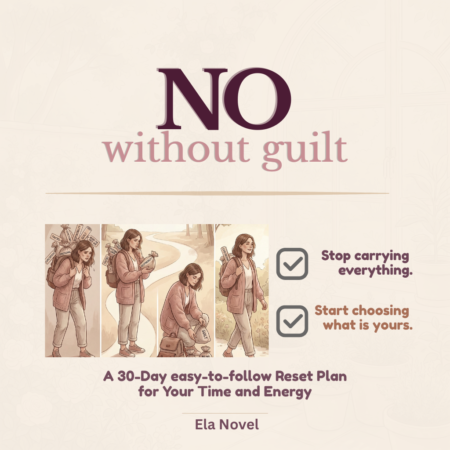
If this resonated, if you recognised the pattern of giving free work to friends and felt the particular exhaustion of an arrangement that keeps costing you while feeling impossible to change, NO Without Guilt is a calm, practical 30-day reset designed to help you shift it.
Not to make you less generous or less warm or less present for the people you love. But to help you become more intentional about what you give, to whom, and from what place inside yourself.
Through short daily reflections and simple actions, it helps you:
✓ Recognise the pattern of giving free work out of guilt rather than genuine generosity
✓ Create a pause before automatically saying yes to the next request
✓ Find warm, clear ways to name your rate without apology or over-explanation
✓ Handle the discomfort of the first no without reversing into another free yes
✓ Build the daily habit of valuing what you built as consistently as your paying clients do
Valuing your work does not make you less kind. It makes you clear. Start now.
Ela’s Love Life Stories is a space for women 40+ who are ready to reclaim their time, their energy, and themselves — not loudly, not dramatically, but quietly and consistently, one small shift at a time.
If this felt true to you — share it with a woman who needed to read it today.