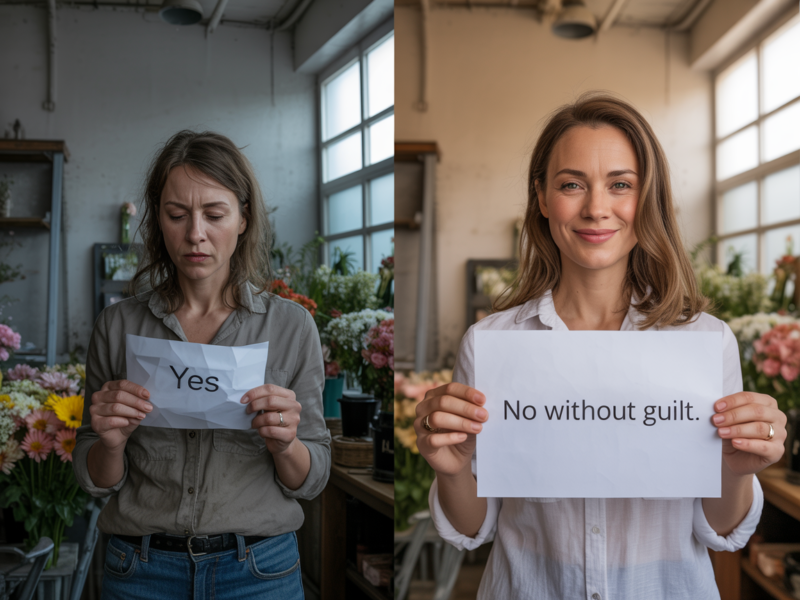
The automatic yes is not a personality trait. It is a habit. And like all habits, it can be interrupted. Here is why the automatic yes is exhausting women over 40 and how to start choosing differently now.
Women who interrupt the automatic yes do not become less loving or less reliable. They become more present. This post shows you exactly what is inside the invisible backpack the automatic yes has been filling, and how to start putting some of it down.
You Did Not Choose to Carry It All. You Just Never Stopped.
There is a particular kind of exhaustion that has nothing to do with how much sleep you got last night.
It lives in the body differently from ordinary tiredness. It is there in the morning before the day has even begun. It follows you through the afternoon and sits beside you in the evening when you finally, briefly, guiltily, stop moving.
It is the exhaustion of the automatic yes.
Not the yes you considered and chose deliberately. Not the yes that came from genuine desire or freely given love.
The yes that happened before you even thought about it. The yes that has become so habitual, so reflexive, so deeply embedded in how you move through your days, that it no longer feels like a choice at all.
It just feels like who you are.
And the weight of all those automatic yeses, accumulated over months and years and decades, is what is making you tired.
Not age. Not weakness. Not the inevitable cost of a full and loving life.
The weight.
And the weight, most of it, was never truly yours to carry.
What the Invisible Backpack Actually Contains
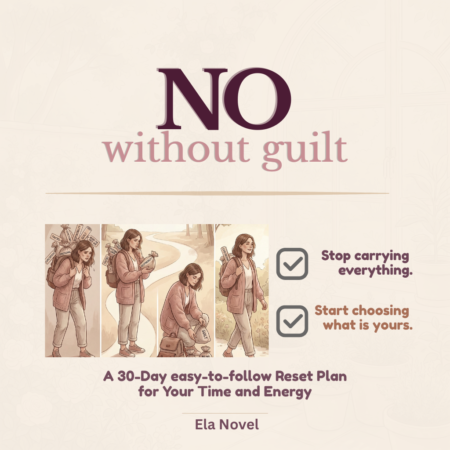
There is a concept that describes what many women carry — an invisible backpack.
You cannot see it. Nobody around you can see it. But you feel it every single day — in the tension in your shoulders, in the running list in your head that never quite empties, in the low-level awareness of everything that needs doing for everyone around you that follows you from room to room and refuses to switch off even when you are supposed to be resting.
Inside that invisible backpack is everything the automatic yes has put there.
The practical load — the appointments remembered and scheduled, the groceries planned and bought, the household managed, the logistics coordinated, the ten thousand small details that keep a shared life running and that somehow all became yours to track.
The emotional load — the feelings absorbed, the tensions smoothed, the comfort given, the worry carried for children and partners and parents and friends who bring their pain to you because you have always been the one who could hold it.
The relational load — the relationships maintained, the occasions remembered, the messages sent, the connections tended, the social fabric of an entire family’s life woven and rewoven by your quiet, consistent, invisible effort.
And underneath it all — the heaviest thing in the backpack, the one most women never name out loud — the weight of believing that all of this is simply what you are supposed to do.
That this is love. That this is what being a good woman looks like. That carrying it all is not a burden but a choice — one you make freely, joyfully, without cost.
Except it has a cost.
It always had a cost.
You just learned very early not to mention it.
Why the Automatic Yes Is So Hard to Interrupt
Understanding why the automatic yes happens is the first step toward changing it — not with judgment, but with genuine clarity.
It was rewarded. From a very young age, most women learn that saying yes — to requests, to needs, to other people’s comfort — is met with warmth, approval and love. And saying no — or even hesitating — is met with disappointment, guilt or the uncomfortable sense of having let someone down. The lesson is absorbed early and reinforced constantly: yes keeps the peace. Yes makes people happy. Yes makes you loveable.
It became identity. Over time, being the person who always shows up — who always helps, who always manages, who can always be counted on — stops being something you do and becomes something you are. The reliable one. The capable one. The one everyone comes to. And identities are much harder to question than habits. People pleasing and identity in women consistently shows that women who define themselves through availability and reliability find it significantly harder to balance everything.
The guilt is immediate and the relief is delayed. When you consider saying no, the guilt arrives instantly — sharp, uncomfortable, hard to sit with. The relief that comes from having protected your time and energy arrives much later, quietly, and is easy to miss. So the automatic yes persists because it removes an immediate discomfort, even as it creates a larger one over time.
Nobody asks about the cost. The people who benefit from your automatic yes — who love you, who depend on you, who have built their lives around your reliability — rarely think to ask whether the arrangement is sustainable for you. Not because they are unkind. But because you have never shown them the weight. You have been too good at making it look effortless.
What Is Actually Yours to Carry — And What Is Not
This is the question at the centre of everything — and most women have never been given permission to ask it honestly.
What is yours: The responsibilities you have genuinely chosen. The love you give freely from a place of abundance. The relationships you tend because they fill you as much as they ask of you. The work that is meaningfully yours — professionally, personally, relationally.
What is not yours: The problems that landed on your shoulders because you were nearby and capable and nobody else stepped forward. The emotions other people have not learned to manage for themselves. The expectations that solidified into obligations before you had a chance to decide whether you agreed to them. The tasks that became yours simply because you did them once and nobody thought to question the arrangement.
The distinction is not always clean. But it is always worth making.
Because just because something landed on your shoulders does not mean it belongs there.
The Pause That Changes Everything
You do not need a dramatic overhaul. You do not need difficult conversations or confrontations or a wholesale renegotiation of every relationship in your life.
You need a pause.
A single moment — between the request and the response — where you stop long enough to ask:
Is this mine?
That pause is where the automatic yes loses its power. Not because you always say no after it. But because the yes that follows a genuine pause is a choice — and choices feel different from habits. They cost less. They carry less resentment. They come from a different place inside you.
The pause is small. It is quiet. Nobody around you will even notice it.
But it is the beginning of something real.
5 Types of Automatic Yes Worth Examining
Not all automatic yeses are equal. Here are five of the most common — and the questions worth asking about each:
1. The Practical Yes “Of course I will sort that out.” Question to ask: Is there someone else who could sort this out? Would they, if I were unavailable?
2. The Emotional Yes “Tell me everything. I am here.” Question to ask: Am I genuinely available to hold this right now? Is absorbing this person’s feelings helping them — or just relieving their discomfort temporarily while adding to mine?
3. The Social Yes “Yes, I will organise it. Yes, I will host. Yes, I will be there.” Question to ask: Do I actually want to do this? Or am I saying yes to avoid the discomfort of saying no?
4. The Guilt Yes “I suppose I should.” Question to ask: If the guilt were not there, would I say yes? Is guilt a good enough reason to carry something?
5. The Identity Yes “This is just what I do. This is who I am.” Question to ask: Did I choose this identity? Does it still serve me? Is it possible that who I am is bigger than what I carry for everyone else?
What Happens When You Start Choosing
Women who begin pausing before the automatic yes — who start asking honestly what is theirs and what is not — describe a consistent sequence of changes.
First, a small discomfort. The guilt of the interrupted habit. The unfamiliarity of a different response. A brief, uncomfortable period of sitting with the displeasure of someone who expected the automatic yes and did not receive it.
Then, something else.
Space.
Small at first — a morning that belongs to her, an evening that is not spent managing someone else’s need, a weekend that does not begin with someone else’s request. But real.
And in that space, something begins to return.
Energy. Presence. The quiet sense of herself that had been buried under the weight of the backpack for longer than she could quite remember.
She does not become colder. She does not become less loving or less generous or less present for the people she cares about.
She becomes more of all of those things.
Because she is no longer running on empty.
Because she has stopped carrying what was never hers.
Your Next Step — The 30-Day Reset
If this resonated — if you recognised the invisible backpack and the automatic yes and the particular exhaustion that comes from carrying too much for too long — the most practical next step is a gentle, structured process for making this shift.
NO Without Guilt is a calm, practical 30-day reset designed to help you interrupt the automatic yes and begin choosing what is genuinely yours to carry — and what is not.
Through short daily reflections and simple actions, it helps you:
✓ Identify the automatic yeses that are costing you the most
✓ Create a genuine pause before you respond to requests
✓ Recognise the difference between what is yours and what simply landed on you
✓ Begin releasing the weight that does not belong to you
✓ Protect your energy and presence without confrontation or guilt
No drama. No confrontation. No losing your kindness.
Just a gentle, consistent practice of choosing differently.
One pause at a time. One honest question at a time. Thirty days.
Ela’s Love Life Stories is a space for women 40+ who are ready to reclaim their time, their energy, and themselves — not loudly, not dramatically, but quietly and consistently, one small shift at a time.
If this felt true to you — share it with a woman who needed to read it today.