Stop always covering at work by asking one different question before you say yes. Women over 40 who make this shift do not become less reliable. They become more respected. Here is how to start now.
Women who stop always covering at work do not stop being team players. They stop being available by default. This post shows you the one question that changes everything and five ways to say no without being difficult.
You Already Knew What Was Coming Before She Finished the Sentence
“Can you cover for me this week? Just until things settle down.”
You have heard some version of this sentence before. More than once. More than three times. More times than you would like to count if you are being completely honest with yourself.
And you already know how it goes.
You pause, just briefly, just enough to feel the familiar internal negotiation, and then you say yes. Because you are capable. Because it is easier in the moment. Because the alternative feels uncomfortable in a way that is hard to justify when you can technically manage it.
So you absorb it. Again.
The extra hours. The rearranged schedule. The quiet adjustment of your own plans to accommodate someone else’s inability to manage theirs. The mental load of carrying both your work and hers while she sorts out whatever it is that always seems to need sorting out.
And somewhere in the middle of managing it all, because you always manage it all, something inside you registers quietly and without drama.
I am tired of this.
Not of work. Not of being competent. Not of being someone people can rely on.
Tired of being the one who always carries what everyone else puts down.
If that feeling is familiar, this post is for you.
How You Became the Person Who Always Covers
It did not start as a pattern. It started as a favour.
The first time you covered, it was a genuine emergency and you were genuinely happy to help. You are that kind of person. Warm, capable, reliable — someone who shows up when it matters and does not make a fuss about it.
And because you handled it so well — because you absorbed the extra work without complaint and delivered without drama — it happened again.
And again.
Not because your colleague is necessarily a bad person. But because you established, through your consistent willingness, that this was something you would do. That asking you was safe. That the yes was dependable.
You trained the people around you — unintentionally, through pure competence and kindness — to see you as infinitely available.
And now, weeks or months or years later, the favour has become an expectation. The emergency has become a pattern. And the yes that used to come from genuine generosity now comes from something else entirely.
Habit. Guilt. The path of least resistance.
The inability to say no without feeling like you are being difficult — when the truth is, you have simply been being too easy for too long.
The Question That Changes Everything
When someone asks you to cover — to take on extra work, to absorb someone else’s responsibility, to adjust your plans to accommodate someone else’s chaos — there are two questions you can ask yourself.
Most women ask the first one.
Can I do this?
And the answer is almost always yes. You are capable. You can figure it out. You always do.
But the first question is the wrong question. Because your capability is not the issue. Your capability was never the issue.
The right question — the one that changes everything — is the second one.
Should I do this?
Should I be the one carrying this? Was this mine to carry in the first place? Is this a genuine emergency or an established pattern? Is my yes helping this person grow — or enabling them to continue not managing their own responsibilities? And what is the cost to me — in time, in energy, in my own work, in my own life — of saying yes again?
These are not selfish questions. They are honest ones.
And honest questions — asked before the automatic yes — are where real change begins.
The Hidden Cost of Always Covering at Work
The cost of being the woman who always covers is rarely visible on the surface. From the outside, you look like someone who handles everything well. Someone indispensable. Someone reliable and strong.
But the cost is real and it is cumulative.
Your own work suffers. When you absorb someone else’s responsibilities, something has to give. Usually it is the deeper, more strategic, more creative work — the work that would actually advance your career — that gets pushed aside in favour of managing the immediate practical demand.
Your resentment grows. Low-level, quiet, persistent resentment. Not the dramatic kind that explodes — the kind that simmers. That makes you dread certain messages. That makes you tense before certain conversations. That accumulates until the workplace itself starts to feel heavy.
Your time disappears. The evenings spent finishing your work because the day was consumed by covering for someone else. The weekends that start with the overhang of an overloaded week. The personal plans quietly rearranged — again — to accommodate a professional obligation you never actually agreed to.
Your professional identity shrinks. When you are always the person managing the overflow — always the reliable one absorbing whatever needs absorbing — you stop being seen as someone with her own priorities, her own career trajectory, her own professional needs. You become infrastructure. And infrastructure does not get promoted. It just gets relied upon.
Your self-respect erodes. Perhaps the most significant cost of all. Every time you say yes when you want to say no — every time you override your own instincts and needs to accommodate someone else — you send yourself a message. And the message, repeated enough times, starts to feel like a truth.
My needs matter less than other people’s convenience.
They do not. They never did.
Why Saying No at Work Feels So Difficult
Understanding the obstacle is part of clearing it. Here is why professional nos feel particularly hard:
The professional stakes feel higher. At work, the fear of being seen as difficult, uncooperative or not a team player can feel very real. Women in particular are acutely aware of the professional cost of being perceived as unhelpful — and the automatic yes is often a response to that awareness.
The relationship is ongoing. You work with this person every day. The discomfort of a no does not end when the conversation does — it follows you to the next meeting, the next corridor encounter, the next team lunch. The ongoing nature of workplace relationships makes boundaries feel more costly than they are in other contexts.
The guilt is immediate and specific. It is not abstract guilt about being a good person. It is specific, immediate guilt about leaving a colleague in a difficult situation. And that specificity makes it harder to dismiss.
You have set a precedent. Every previous yes has made the next no harder. The person asking has a reasonable expectation, built on experience, that you will say yes. Changing that expectation feels — and sometimes is — uncomfortable.
All of these obstacles are real. And none of them are reasons to keep carrying what is not yours.
5 Ways to Say No at Work — Without Being Difficult
You do not need to be cold, confrontational or unkind. You need to be clear.
Here are five approaches — each one warm, professional and firm:
1. The honest redirect “I am at capacity this week and I would not be able to give it the attention it needs. Is there someone else who could take this on?” You are not refusing to help. You are being honest about your capacity and redirecting toward a better solution.
2. The conditional yes “I can help with part of this — but not all of it. What is the most important piece?” This is not a full no. But it is a boundary. You are defining what you will carry rather than automatically absorbing everything.
3. The pause “Let me check what I have on and come back to you by end of day.” This interrupts the automatic yes without committing to a no. And in that pause, you make a genuine decision rather than a habitual one.
4. The honest no “I am not going to be able to cover this time — I have too much on my own plate right now.” No explanation beyond that. No lengthy justification. No apology. A clear, warm, professional no.
5. The pattern conversation “I want to flag something. I have covered quite a few times recently and I am finding it difficult to manage alongside my own workload. I think we need to find a different solution going forward.” This is the harder conversation — but the most important one when a pattern has established itself. It is not a complaint. It is a professional conversation about workload and sustainability.
Which Version of You Do You Want to Keep Feeding?
There are two versions of you at work.
The first version says yes automatically. She absorbs what everyone puts down. She adjusts her plans, manages the overflow, stays late, starts early — and does it all without complaint because that is who she is and because the alternative feels uncomfortable.
She is reliable. She is capable. She is exhausted.
And she is slowly disappearing into her own competence.
The second version pauses before she answers. She asks herself whether something is hers to carry before she picks it up. She says no — warmly, professionally, without drama — when the answer to that question is no.
She is also reliable. She is also capable.
But she is present. She has energy. Her work reflects her actual ability because she is not spending half of it managing someone else’s.
And she respects herself in a way that, gradually, teaches the people around her to respect her too.
Both versions are available to you.
The question is not which one you are capable of being.
The question is which one you choose to feed.
Your Next Step — 30 Days to a Different Answer
If this resonated — if you recognised yourself in the woman who always covers and felt the particular exhaustion of that recognition — the most practical next step is a structured process for changing the pattern.
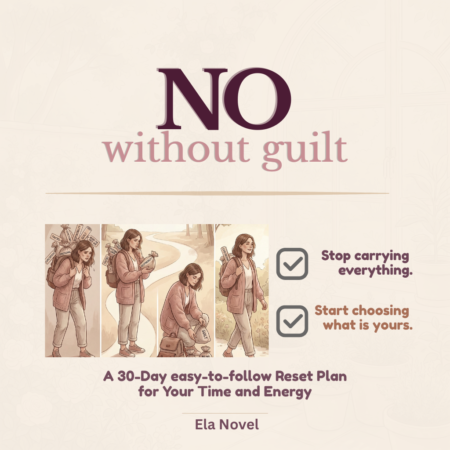
NO Without Guilt is a calm, practical 30-day reset designed to help you interrupt the automatic yes — at work, at home, in every relationship where your needs have been quietly coming last.
Through short daily reflections and simple actions, it helps you:
✓ Identify the patterns of automatic yes that are costing you the most
✓ Create a genuine pause before you respond to requests
✓ Find the words for professional and personal nos that are warm and clear
✓ Manage the guilt that follows a boundary without letting it reverse your decision
✓ Build the consistent habit of choosing what is genuinely yours — and releasing what is not
No confrontation. No drama. No losing your warmth or your professionalism.
Just a different answer. Beginning now.
Ela’s Love Life Stories is a space for women 40+ who are ready to reclaim their time, their energy, and themselves — not loudly, not dramatically, but quietly and consistently, one small shift at a time.
If this felt true to you — share it with a woman who needed to read it today.