Same trip. Same destination. And yet she is carrying everything.
The mental load women carry in relationships is rarely assigned. Nobody sits down and divides it up. It just lands. Quietly, gradually, one small thing at a time. Until one day you look at the picture you are making and think: this is not what I agreed to.
If that image feels familiar, this post is for you.
Why the Mental Load Women Carry Stays Invisible
Same trip. Same destination. Same amount of time spent getting ready and walking out the door.
One bag.
And everything else.
The extra bags were not assigned. Nobody said: you take the rolled blanket, the large tote, the extra bag and the general awareness of everything we might have forgotten. He takes the one light bag.
It just happened. The way it always just happens.
She was already holding something, so she picked up the next thing. And the next. Because she was managing it, nobody paused to redistribute. Nobody looked at the picture they were making and thought: this does not look equal.
Because they never agreed to it. But they never disagreed either. It simply was not a conversation that happened. And in the absence of that conversation, the default established itself.
She carries more. He carries less. Both of them have been living inside that arrangement long enough that it has stopped looking like an arrangement at all.
It just looks like how they travel.
Until you see it.
He Is Not Ignoring It — He Genuinely Does Not Feel It
This is the question that matters most. And it is the hardest to answer without either excusing the imbalance or blaming the person who is not carrying enough.
He is not ignoring it. He genuinely does not feel it.
That sounds like an excuse. It is not. It is an explanation. An excuse removes responsibility. An explanation describes reality so that reality can be changed.
What does not belong to you does not register the same way it registers to the person carrying it.
The extra bag she is holding is present in her awareness. Physically, cognitively, in the planning it required and the weight it adds. It is fully present to her every moment.
To him, it is not present at all. Not because he decided to ignore it. But because it is not his. It was picked up before he had a chance to pick it up. It became part of her load so automatically that it never entered his awareness as something he might share.
Research on the mental load women carry shows that invisible work consistently falls to women even when both partners believe the division is equal.
This is not uniquely male. It is human. What we carry, we feel. What we never carry, we do not know the weight of.
He has been living, in good faith, inside an arrangement he did not choose and does not see clearly. The arrangement works well for him. It was established before he thought to question it.
This does not make it fair. It does not mean noticing is not his responsibility.
But understanding that he genuinely does not feel what you feel changes how you approach the conversation about fixing it.
How the Extra Became Normal
The extra did not announce itself. It accumulated.
The first extra thing was so small it barely registered. You were already there, already holding something, already aware of what needed doing. So you did it. Without making a thing of it.
Then it happened again.
Each time was individually small. Each time was absorbed without comment because the absorption was easier than the conversation. Each time it became, through repetition, a little more settled into the arrangement. A little more yours by default.
Until the extra had been yours for long enough that it no longer felt like extra. It felt like normal. Your normal.
The Most Important Part of How It Became Invisible
You stopped seeing it too.
Not completely. Some awareness remained. The particular tiredness that comes from carrying more than your share. The low-level resentment that surfaces and then gets suppressed because naming it feels like making a big deal of something ordinary.
But the day-to-day visibility of it faded as the normalising deepened.
Both of you are living inside the same invisibility. Just from different sides of it.
He does not see the extra because it has always been yours. You do not fully see it either because it has been yours for so long it stopped looking like extra at all.
Until the image. Until the moment the normal revealed itself as something that was built, not discovered. And could therefore be rebuilt differently.
What the Mental Load Women Carry Actually Contains
Normal carries a great deal that belongs somewhere else.
The physical extra. The additional bags. The items carried because they were there and nobody else picked them up. The body doing more work than the body next to it, consistently, without acknowledgement.
The planning extra. The thinking that happened before the physical doing. The awareness that the blanket was needed, the toiletries were packed, the itinerary accounted for.
The mental load that made the physical load possible. The invisible work that nobody sees because it happened inside your head before the trip began.
The responsibility extra. The ownership of outcomes. The awareness that if something is forgotten, it fell through the gap in your awareness, not in the shared awareness of two people equally responsible.
The emotional extra. The management of how the imbalance makes you feel. The suppression of the resentment. The ongoing performance of fine when fine is not entirely accurate.
All of this is in the extra bags. And none of it was ever formally yours.
Why the Shift Starts With You
This is the part most often misunderstood.
The shift does not begin when he suddenly sees the bags and picks them up. It does not begin when he notices the imbalance without being told and fixes it voluntarily.
This can happen. Occasionally. When the visibility is made impossible to avoid and the person involved is genuinely willing to look.
But waiting for it to happen keeps most women waiting indefinitely.
The shift starts when you stop carrying what was never yours by default.
When you put something down and wait to see what happens. When you name the pattern once, clearly, without blame, and open the door to a different arrangement. When you stop absorbing the extra automatically and create the space in which he has no choice but to become aware of it.
Not because it is your job to fix an imbalance you did not create. But because waiting for the awareness to arrive on its own has not worked. And it is unlikely to start working now.
The visibility has to be created. And you are the only one who currently has enough visibility into the arrangement to create it.
How to Put the Extra Bags Down Without Drama
You do not need a confrontation. You need a redistribution. Quiet, clear and consistent.
Stop picking things up before he has a chance to. The bag you automatically reach for before he reaches for anything, leave it. For a moment. Long enough to see if he picks it up. You may be surprised how often the only reason you carry it is that you got there first.
Name the extra once, specifically. Not in a moment of frustration. In a calm, ordinary moment. “I have noticed I end up carrying quite a bit more than you when we travel. I would like to change that. Can we divide this differently?” Specific. Practical. Without blame.
Let the gap exist. When you stop picking up the extra automatically, there will be a gap. A moment when something is not picked up and nobody is rushing to fill it. Let it sit. It is uncomfortable. It is also necessary. The gap is what makes the invisible visible.
Ask Specifically, Not Generally
Ask for specific things, not general fairness. “Could you carry this?” works better than “You never carry enough.” Specific requests, made warmly and consistently, build a different pattern more effectively than general appeals to fairness.
Redistribute the planning, not just the carrying. The physical bags are the visible tip of a much larger extra. The mental load of preparation is where most of the work actually lives. “I would like you to be responsible for packing your own things and thinking about what we need, not just doing what I ask you to do.” That conversation changes more than who carries the bags.
The Trip Where the Bags Are Shared
There is a version of this trip where the load is equal.
Not because it was demanded or achieved through conflict, but because the arrangement was looked at honestly, by both people, with enough goodwill to see clearly, and changed.
In that version, she still carries bags. She is not trying to carry nothing. She is trying to carry her share. Not her share plus everything that was never formally assigned but became hers by default.
In that version, he carries more. Not because he was forced to. But because when the invisibility was removed, when the arrangement was named and the gap was allowed to exist, he stepped into it.
Because most people, when they genuinely understand the weight of what someone else has been carrying, are willing to carry more.
In that version, the trip is the same. The destination is the same. The love between two people is the same. Possibly stronger, because the resentment that had been quietly accumulating has been addressed rather than suppressed.
The only thing that is different is the bags. And how they are distributed. And the quiet, specific, blame-free conversation that made a different distribution possible.
Your Next Step — 30 Days to Put the Extra Down
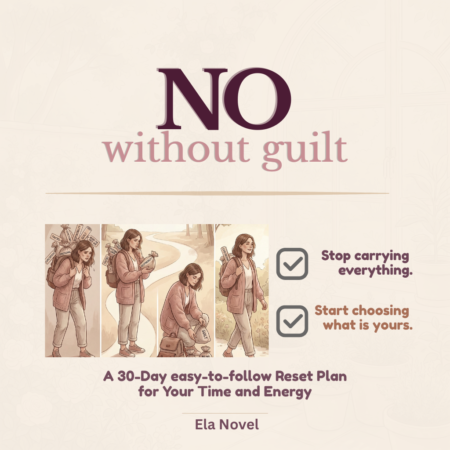
If this resonated, if you recognised the extra bags and the invisible accumulation and the normal that was never balanced, NO Without Guilt is a calm, practical 30-day reset designed to help you begin putting some of it down.
Not through confrontation or resentment. But through the kind of quiet, clear, consistent redistribution that changes not just who carries the bags but the entire dynamic of who is responsible for what.
Through short daily reflections and simple actions, it helps you:
✓ Identify the extra you have been carrying that was never formally yours
✓ Stop picking things up automatically before anyone else has a chance to
✓ Find the words for a redistribution conversation that is warm, specific and effective
✓ Allow the gap to exist long enough for the invisibility to become visible
✓ Build a new normal, gradually and honestly, without losing the relationship in the process
Normal is not the same as balanced. But balanced is available. And it starts when you put the extra down.
Ela’s Love Life Stories is a space for women 40+ who are ready to reclaim their time, their energy, and themselves — not loudly, not dramatically, but quietly and consistently, one small shift at a time.
If this felt true to you — share it with a woman who needed to read it today.