Your time keeps getting used before you ever get to choose what to do with it.
Women over 40 rarely lack hours in the day. What they lack is the chance to reclaim their time before someone else claims it first. If your day feels like it belongs to everyone except you, this post is for you.
What Would You Do If the Day Were Yours?
A day that is yours.
Not filled before it begins. Not scheduled around everyone else’s needs. Not already spoken for by the time you finish your first cup of coffee.
Just yours.
What would you do with it?
Would you rest properly, without the hum of everything undone following you into the stillness? Would you move, not because exercise is on the list but because your body wanted to and you had the energy to listen? Would you put on a song you love and let it fill the room and forget everything for the length of it?
Or has it been so long since your time genuinely belonged to you that the question itself is hard to answer?
Not because you have no desires. But because the habit of asking what you actually want has grown so unfamiliar that it no longer arrives on its own.
That is what this post is about.
Having Time Is Not the Same as Having Your Time
Most women over 40 have time. Hours in the day. Minutes between tasks. Evenings that exist after the work and the managing and the showing up for everyone else is done.
But that is not the same as having your time.
Having time means the hours exist. Having your time means the hours are genuinely available to you. Unspoken for. Not already claimed by someone else’s need before you had a chance to choose.
Your time gets used before you choose. That is what most women mean when they say they have no time. Not that the hours do not exist. But that by the time they arrive, they are already gone.
The morning gets claimed by the logistics of getting everyone else started. The afternoon gets claimed by requests and tasks and things that were nobody’s official responsibility but landed on you. The evening gets claimed by recovery from the day.
And somewhere in all that claiming, the version of you who would have chosen something different keeps waiting.
Not gone. Just waiting.
For a moment that keeps getting used before it arrives.
Why You Stop Asking What You Want
There is a question at the centre of a life that is genuinely yours.
What do I want to do with this moment?
It is a simple question. A small one. But it requires your time to be unspoken for before it can be meaningfully asked. Because if the moment is already claimed, the question is pointless before it is finished.
So gradually, you stop asking it.
Not as a decision. Just as the natural result of asking a question and finding, consistently, that the answer changes nothing because the time is not available anyway.
You stop asking what you want to do with a morning because the morning is always already full. You stop imagining what a free afternoon might feel like because it has been so long that imagining feels more like grief than planning.
After years of this, something quieter happens.
You lose fluency in your own desires.
Not the desires themselves. But the ease of reaching them. The immediate, unhesitating sense of what you would do if the time were genuinely yours.
That fluency comes back. But it needs practice. And practice needs moments. Small, protected, genuinely available moments in which the time is yours before it is anyone else’s.
Why Women Over 40 Struggle to Reclaim Their Time
Understanding why this happens is essential to changing it.
The default is other-directedness. For most women, the default direction of a day is outward. Toward the needs and requests of the people around them. The inward direction, toward your own needs and desires, is not the default. It requires effort. And effort in a full life tends not to get made unless it is deliberately protected.
The claiming happens before you notice. By the time you realise your morning is being used, it already is. Requests arrive early. Logistics begin before the day properly starts. You are already in other-direction mode before you had a chance to ask what you would have chosen for yourself.
There is no structure protecting your time. Other people’s claims on your time are structural. They appear on calendars and in conversations. Studies on time poverty in women consistently show that women have significantly less free time than men, even when both partners work full time. Your own claim on your time exists only if you actively create it.
The guilt feels bigger than the cost. When a moment is briefly available, the guilt of using it for yourself often feels larger than the pleasure of the using. The sense that you should be doing something. That rest is not earned. So the moment goes to the list instead of to you.
What She Does With a Moment That Is Hers
The woman dancing in the living room with her headphones on is not doing something extraordinary.
She is doing something ordinary. Something small. Something that takes four minutes, produces nothing measurable and appears on no list of important things.
She put on a song she loves. She danced to it. Alone. In her living room. In the middle of a morning she had decided, before anyone else could claim it, belonged to her.
That is all. And it is everything.
Because the dancing is not really about the dance. It is about the decision that came before it. The decision that this moment belongs to her. That the question “what do I want to do with this?” was asked and answered and honoured.
That is the practice.
Done consistently, in small moments, it does something significant over time. It restores fluency. The wanting becomes easier to reach. The time that is genuinely yours starts to feel like something you know how to live in, not something foreign and uncomfortable.
5 Ways to Start Claiming Moments That Are Yours
You do not need large blocks of time. You need small, protected moments. Claimed before they are used. Honoured when they arrive.
1. Claim the first ten minutes of your morning. Before the phone. Before the messages. Before the logistics of getting everyone else started. Ten minutes that belong to you before they belong to anyone else. Not for productivity. For whatever you actually want. Even if that is just sitting quietly with your coffee.
2. Ask the question once a day. What do I want to do with this moment? Not what should I do. Not what needs doing. What do I want. Even if the answer is small. Ask it. Wait for it. Honour it when it arrives.
3. Protect one longer moment each week. An afternoon. An evening. A Saturday morning. Something with enough space for the wanting to arrive properly. Not available for other people’s needs. Yours. On the calendar with the same firmness as a meeting.
Two More Steps That Help You Reclaim Your Time
4. Notice what brings you back to yourself. Pay attention this week to the moments when something in you relaxes. The song that does it. The walk that does it. The quality of a morning that has not yet been claimed. Notice what produces that feeling. Then pursue it deliberately as a regular part of your life.
5. Give yourself permission to not be useful. This is the hardest one and the most important. You do not have to earn the moment. You do not have to finish everything first. You are allowed to have time that is yours simply because you are a person. And people are allowed to have moments that belong only to them.
She Is Still There
The version of you who knows what she would do with a moment that was genuinely hers has not gone anywhere.
She is still there underneath the capable, reliable, always-available woman you have become.
She has just been waiting for space.
Not a lot of space. Not a restructured life or a cleared calendar. Just a crack in the door.
A morning claimed before it is used. A question asked and honoured. A song played because you wanted to hear it.
That is how she comes back.
Not all at once. Not perfectly. But one small claimed moment at a time.
And when she does, when you feel her briefly in the middle of an ordinary morning that you decided was yours before it was anyone else’s, you will remember why this matters.
Your Next Step — 30 Days to Reclaim Your Time
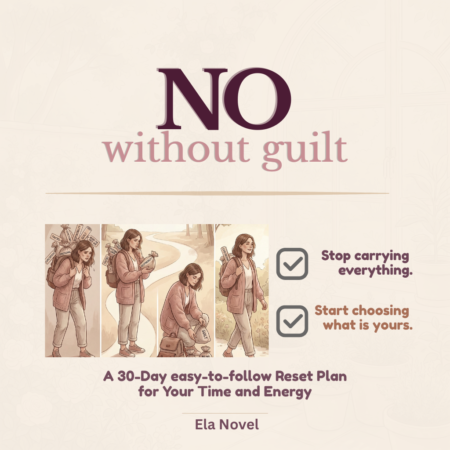
If this resonated, if you recognised the time that gets used before you choose and the version of yourself that has been waiting for space, NO Without Guilt is a calm, practical 30-day reset designed to help you begin claiming it back.
Not by adding more to your life. By creating the small, protected, genuinely yours moments that gradually restore your relationship with your own time.
Through short daily reflections and simple actions, it helps you:
✓ Recognise where your time is being used before you get to choose
✓ Build the daily habit of asking what you actually want before consulting everyone else
✓ Claim small moments that belong to you, consistently and without guilt
✓ Restore fluency in your own desires and preferences
✓ Create a life in which your time is yours before it is anyone else’s
She is still there. She just needs space. And the space starts now.
Ela’s Love Life Stories is a space for women 40+ who are ready to reclaim their time, their energy, and themselves — not loudly, not dramatically, but quietly and consistently, one small shift at a time.
If this felt true to you — share it with a woman who needed to read it today.