Your time does not disappear. You give it away. And you can choose to stop.
Women who stop giving their time away by default do not find more hours. They make different choices about the hours they already have. This post shows you exactly how they do it, and how you can start today.
You Have the Same 24 Hours. So Why Do Yours Feel Like Everyone Else’s?
You have the same number of hours as the woman whose life looks lighter than yours. The same as the friend who made it to that class she wanted to try. The same as the colleague who left at a reasonable hour.
Same hours. Very different experience of them.
And somewhere underneath the busyness and the fullness of a day that fills up before it properly begins, a question forms that is uncomfortable to finish.
Why does so little of my time feel like mine?
You know where the time goes in the practical sense. You could account for most of it, hour by hour, request by request. But that is not the real question.
The real question is quieter than that.
If that question feels familiar, this post is for you.
Your Time Does Not Disappear — You Give It Away
Most women who feel their time has disappeared believe, on some level, that something happened to it.
That the circumstances of their life, the demands of family, the requirements of work, the needs of the people around them, simply consumed it.
But time does not disappear. It gets given away.
One yes at a time. One absorbed request at a time. One moment of it is easier if I just do it myself at a time.
Your time did not vanish into a life that was too full. You allocated it, consistently and often without full awareness, to the requests and needs and expectations of the people around you. Until the idea of time belonging to you became almost theoretical.
Not stolen. Given. By you. Through the accumulated yeses of days and weeks and years.
This distinction matters. Not to assign blame. But because of what it means for the solution.
If your time was taken, you can only hope for circumstances to change.
If your time was given, you can choose to give it differently.
How a Day Gets Full Before It Begins
Your day fills in layers. Understanding this is the first step toward interrupting it.
The first layer is not the problem. Fixed commitments, genuine responsibilities, the things you chose and would not wish away. Work. Family. The real obligations of a real life.
The second layer is where the giving away starts.
The request that arrives before you have had coffee. Small, reasonable, accepted without thought because questioning it would cost more than just saying yes. The task that attached itself to your morning because you noticed it needed doing. The favour that seemed brief and turned out not to be.
The third layer arrives mid-morning. Follow-ups. Check-ins. Things not on any list but landing on you because you are available, capable and the most likely person to handle them efficiently.
By the afternoon the day is full. Not the satisfying full of a day well spent. The other kind. The kind that leaves you tired before the evening has begun. The kind that makes whatever small space remains feel too thin to spend on anything purely and simply yours.
So you spend it recovering. Preparing for tomorrow. Managing the overhang of today.
This is not a calendar problem. It is not a time management problem. Waking up earlier will not fix it. A better system will not fix it.
It is a giving-away problem. And it needs a different kind of solution.
What Women With More Space Actually Do Differently
The woman whose life looks lighter than yours does not have more hours. Her days are lighter because of quiet, consistent decisions about what she will and will not give her time to.
She says not this time to requests that cost her more than they give. She lets some things wait rather than absorbing them automatically. She protects pockets of her day the way most people protect appointments. Fixed. Not available for someone else’s request to fill.
She is not selfish. She is not cold. She is not less loving or less present for the people she cares about.
She is more deliberate about the giving.
She gives her time when she chooses to. She protects it when she needs to. The distinction between chosen giving and automatic giving is what makes her days feel different from yours.
Research on time use and wellbeing in women consistently shows that women who protect time for themselves report significantly higher satisfaction and lower rates of burnout.
Same 24 hours. A completely different relationship with them.
What Giving Your Time Away by Default Actually Costs You
The tiredness at the end of a full day is obvious. But the costs go deeper.
You lose the sense that your life is yours. When your days reflect everyone else’s priorities rather than your own, life starts to feel like something you manage rather than something you live. That feeling accumulates quietly and significantly.
You lose access to what you actually want. Time spent entirely on other people’s needs leaves no time for discovering your own. After years of this, many women find the question “what do I want?” genuinely hard to answer. Not because the wants disappeared. But because ignoring them for so long made them go quiet.
You lose energy for what matters most. Giving away your time means giving away the attention and presence that go with it. Those resources stop being available for the relationships that fill you, the work that matters to you, the living of a life that is actually yours.
You lose the model. Children who watch you give your time away automatically learn that this is what women do. Showing them a woman who values and protects her own time is one of the most important things you can give them.
How to Stop Giving Your Time Away — Without Overhauling Your Life
You do not need to restructure your whole day. You need to interrupt the automatic giving. Once, then again, then consistently enough that a different pattern forms.
Protect the first hour. Before requests begin arriving. Before the layers start accumulating. Not for productivity. Not for a morning routine that becomes another obligation. Just for yourself. Whatever that means for you on a given morning. That hour belongs to you before it belongs to anyone else. You need to stop giving your time away.
Notice before you accept. For one week, pay attention to the moment before you say yes. Not to change anything yet. Just to notice. The speed of the acceptance. The absence of deliberation. The automatic quality of the giving. Seeing the pattern clearly makes interrupting it possible.
Introduce a delay. The most practical single change you can make is a brief pause before responding. “Let me check and come back to you.” This interrupts the automaticity without requiring you to say no. It creates a moment of genuine choice between the request and the response.
Two More Steps That Help You Stop Giving Time Away
Treat your time like an appointment. The meetings and commitments on your calendar do not get cancelled casually. Try treating time that belongs to you with the same protection. Block it. Name it. When something tries to fill it, treat it the way you would treat a scheduling conflict. With regret and a redirect.
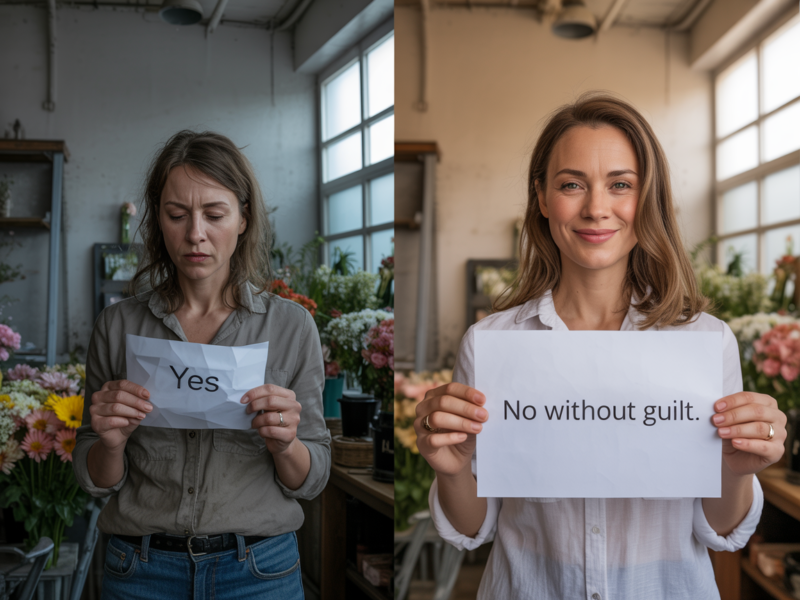
Notice the difference between giving from want and giving from guilt. The yes that comes from genuine desire feels different from the yes that comes from habit or discomfort. Start noticing which is which. The guilt yes is the one to examine first.
Your Time Is Finite. And It Is Yours.
Every hour given to one thing is an hour unavailable for something else. Every yes is also a no to something. The only question is whether you choose what you say no to, or whether the automatic yes chooses for you.
Your time belongs to you. Not at the expense of the people you love or the responsibilities you chose. But in the fundamental sense that you are the person who decides how it gets allocated. Not by default. Not by whoever asks first. Not by the accumulated expectation of people who rely on your automatic availability.
By you. Deliberately. According to what actually matters.
Same 24 hours as everyone else.
The only difference is the relationship you choose to have with them.
Your Next Step — 30 Days to Stop Giving Your Time Away
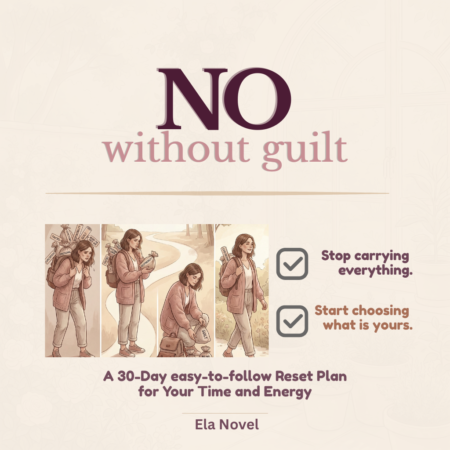
If this resonated, if you recognised the giving-away pattern and the exhaustion of days full of everything except what is yours, NO Without Guilt is a calm, practical 30-day reset designed to help you change it.
Not by adding more structure to an already full life. By interrupting the automatic giving and replacing it with something more deliberate, more sustainable and more genuinely yours.
Through short daily reflections and simple actions, it helps you:
✓ Recognise where your time goes without your full awareness
✓ Create a genuine pause before the automatic yes
✓ Tell the difference between chosen giving and habitual giving
✓ Protect pockets of your day consistently and without guilt
✓ Build the daily habit of treating your time as the valuable resource it is
Your time does not disappear. It gets given away. And you get to decide whether that continues. Start now.
Ela’s Love Life Stories is a space for women 40+ who are ready to reclaim their time, their energy, and themselves — not loudly, not dramatically, but quietly and consistently, one small shift at a time.
If this felt true to you — share it with a woman who needed to read it today.