The too many roles women carry do not arrive all at once. They accumulate quietly, one hat at a time, until the pile becomes impossible to balance.
This post shows you which roles are truly yours and how to start putting the rest down now.
Women who put some of their roles down do not stop being devoted mothers, partners, friends or colleagues. They stop wearing hats that were never formally theirs. Here is how to tell the difference and what to do about it.
It Did Not Happen All at Once
Nobody handed you a stack of hats and said: here, wear all of these, indefinitely, without complaint.
It happened the way all accumulation happens. Gradually. Quietly. One hat at a time.
The first one fit easily — a role you chose, a responsibility you wanted, a relationship you stepped into with genuine enthusiasm. You wore it well. You were good at it. It felt right.
And because you wore it so well, another arrived.
And then another.
Each one individually manageable. Each one a reasonable addition to what was already there. Each one accompanied by the quiet validation of being needed, being trusted, being the person people turned to when things needed doing or fixing or holding together.
Until one day you looked in the mirror and could not quite see yourself beneath the pile.
Not because any single hat was wrong. But because nobody — not even the most capable, most loving, most generous woman alive — was designed to wear all of them at once.
All the time.
Without rest.
Without anyone noticing the weight.
The Invisible Architecture of a Life Built Around Everyone Else
There is a particular way that capable women end up carrying everything — and it is worth understanding clearly, not to assign blame, but to see the pattern for what it is.
It begins with competence.
You are genuinely good at the things you do. You manage well. You remember things. You anticipate needs before they are expressed. You solve problems efficiently and without drama. You are, by any reasonable measure, exceptionally capable.
And competence — particularly in women — functions as an invitation.
Not a conscious one. Not a malicious one. But an invitation nonetheless.
Because when someone handles something well — when they absorb a responsibility without complaint and deliver without drama — the natural conclusion of the people around them is: she can handle this. She is fine. She does not need help. We can give her more.
And so more arrives.
Not because the people around you are unkind. But because your capability made the asking feel safe. Your reliability made the expectation feel reasonable. Your consistent yes made the assumption of the next yes feel inevitable.
And you kept accepting. Because each individual ask was manageable. Because saying no felt harder than saying yes. Because somewhere along the way, being the one everyone counts on became part of how you understood yourself.
Until the pile became too tall to balance.
And still — because you are who you are — you kept balancing it.
Why Nobody Noticed You Were Struggling
This is the part that is hardest to say out loud — and perhaps the most important.
Nobody noticed because you did not let them.
Not deliberately. Not as a conscious strategy of concealment. But because you are skilled at managing — and managing, for women who carry too much, eventually extends to managing how they appear.
You learned early that showing the weight made people uncomfortable. That admitting you were struggling produced either unhelpful advice or awkward sympathy or — worst of all — the suggestion that perhaps you could not handle as much as everyone thought.
So you got better at the performance. Smoother. More seamless. Better at making the impossible look ordinary.
Research on women and role overload consistently shows that women who perform competence under pressure are significantly less likely to receive offers of help, precisely because their capability makes the need for help invisible to the people around them and the more invisible the cost became to everyone around you, the more invisible it became to yourself.
Because when you spend long enough pretending that the weight is manageable, you start to lose track of what manageable actually feels like. The exhaustion becomes the baseline. The tension in your shoulders becomes normal. The low-level depletion becomes just the way things are.
Until something — a quiet moment, an unexpected question, a morning when the weight is just slightly too heavy to pretend otherwise — cracks the performance open.
And you see it clearly, perhaps for the first time in years.
This is too much.
This was always too much.
And I have been carrying it alone.
The Roles You Chose — And the Ones That Simply Arrived
Here is a distinction worth making carefully and honestly.
Not all of the hats you are wearing are ones you actually chose.
Some of them are. The roles you stepped into deliberately, with full awareness of what they would ask of you, because they aligned with your values and your love and your genuine sense of who you want to be. These hats belong on your head. They are yours.
But some of them arrived without your explicit agreement.
The role of the family organiser — did you choose that, or did it simply accumulate because you were the most organised person in the household and nobody else stepped forward?
The role of the emotional support system — did you choose that, or did it happen because you were warm and available and people learned they could bring their pain to you?
The role of the workplace problem-solver — did you choose that, or did it become yours because you were capable and reliable and the path of least resistance for everyone around you?
The role of the person who remembers everything — did you choose that, or did it happen because you remembered once, and then again, and then the forgetting of everyone else became something you quietly compensated for without anyone ever asking whether you wanted to?
The distinction matters.
Because the hats you chose — you can wear with intention, with genuine ownership, with the knowledge that they are yours.
The hats that simply arrived — those are the ones you are allowed to examine. To question. To set down.
Not all of them. Not all at once. But honestly, one at a time.
5 Roles Women Over 40 Are Allowed to Renegotiate
Here are five of the most common accumulated roles — and the honest questions worth asking about each:
1. The Family Organiser The one who tracks every appointment, every school event, every family obligation, every social commitment for an entire household. Question to ask: Is there a reason this has to be mine alone? What would happen if I stopped tracking some of it?
2. The Emotional First Responder The one everyone calls when something goes wrong. The first port of call for every crisis, every bad day, every relationship difficulty in the lives of the people around her. Question to ask: Am I genuinely available for this right now? Is absorbing this helping — or have I become a substitute for the professional support some of these people actually need?
3. The Workplace Absorber The one who takes on the overflow, covers for colleagues, manages the gap between what needs doing and what everyone else is willing to do. Question to ask: Is this officially my responsibility? Would anyone cover for me if the situation were reversed?
4. The Family Memory The one who remembers birthdays, anniversaries, preferences, histories — the living archive of an entire family’s relational life. Question to ask: What would happen if I let some of this go? Would others step in — or would the world actually end?
5. The Fixer The one everyone brings their problems to because she always knows what to do. Whose solutions are so reliable that the people around her have stopped developing their own. Question to ask: Is my fixing helping these people grow — or helping them stay comfortable not having to solve things for themselves?
You Are Allowed to Put Some of Them Down
This is the sentence that most women need to hear — and the one that is hardest to believe after years of carrying everything.
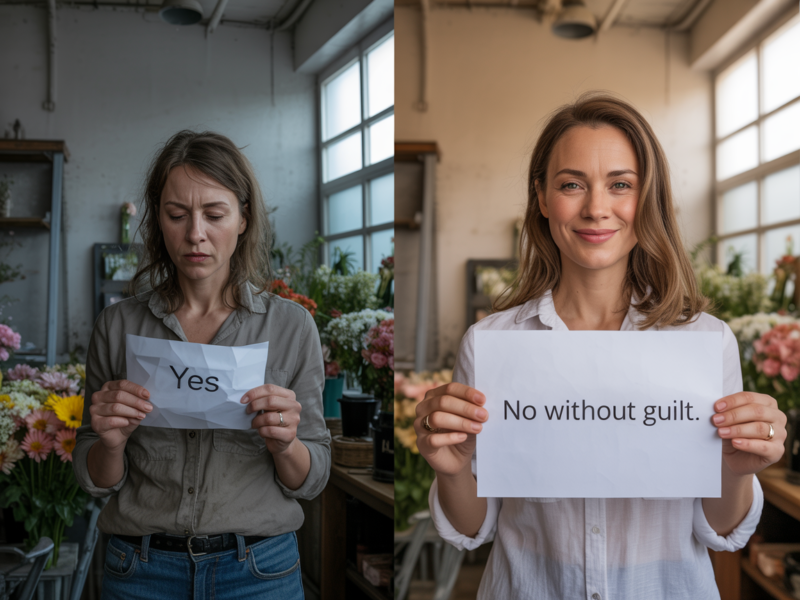
You are allowed to put some of the hats down.
Not all of them. Not permanently. Not in a dramatic gesture of refusal or a wholesale withdrawal from the people and responsibilities you love.
Just some of them. Quietly. For now. With the honest acknowledgement that you were never meant to wear this many at once.
You are allowed to pause before accepting the next one. You are allowed to hand one back and say: I do not think this was ever really mine. You are allowed to step back from a role you have been performing out of habit rather than genuine choice. You are allowed to not be the one — every time, automatically, without question — who carries what everyone else puts down.
This is not abandonment. It is not selfishness. It is not a failure of love or care or commitment.
It is the recognition that you are a person — not just a function. That your capacity is real — and finite. That the people who genuinely love you do not need you to exhaust yourself in order to feel loved.
And that a version of you with fewer hats — present, rested, genuinely yourself — gives more to everyone around you than a version of you that is disappearing under the pile.
Your Next Step — A Gentle 30-Day Reset
If this resonated — if you counted the hats and felt the weight of them — the most practical next step is a gentle, structured process for beginning to set some of them down.
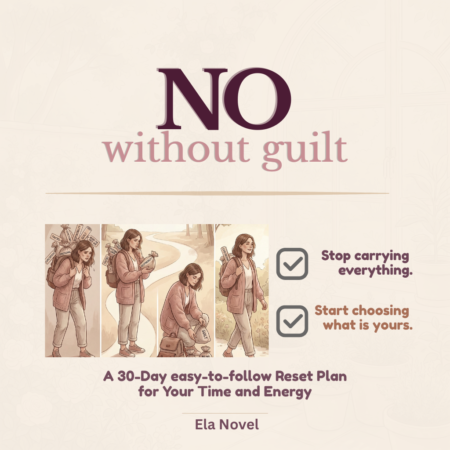
NO Without Guilt is a calm, practical 30-day reset designed to help you do exactly that.
Not to stop caring. Not to withdraw from the roles that genuinely belong to you. But to become more intentional about which roles you are choosing — and which ones simply arrived, and have been there ever since, because nobody ever thought to question the arrangement.
Through short daily reflections and simple actions, it helps you:
✓ Identify the roles you chose versus the ones that simply accumulated
✓ Create a pause before accepting the next hat
✓ Begin renegotiating the arrangements that were never formally agreed to
✓ Protect your time and energy without guilt or confrontation
✓ Return to yourself — beneath all the roles — as someone with her own needs, her own desires, her own life
You keep the hats that are genuinely yours. You finally put down the rest.
Ela’s Love Life Stories is a space for women 40+ who are ready to reclaim their time, their energy, and themselves — not loudly, not dramatically, but quietly and consistently, one small shift at a time.
If this felt true to you — share it with a woman who needed to read it today.