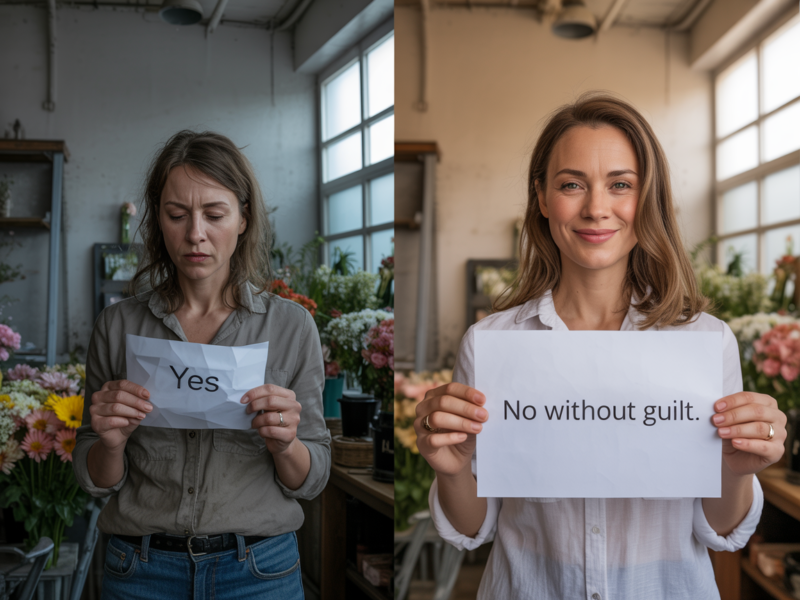
You notice everything. You handle everything. And nobody notices that you notice.
Sharing the load in a relationship is not too much to ask. But most women wait for someone else to notice the imbalance before they say anything. This post explains why that waiting rarely works, and what to do instead starting now.
You Notice Everything. Nobody Notices That You Notice.
You see what is running out before anyone else does. You track what needs doing before it becomes urgent. You anticipate the need, address the gap, manage the logistics, quietly and efficiently, without announcement. Then you move on to the next thing nobody else has spotted yet.
You have been doing this for so long it feels like just the way you are. The one who notices. The one who handles it. The one who keeps the whole thing running while everyone else moves through their days inside the infrastructure you quietly built and consistently maintained.
And somewhere underneath all the noticing and the handling and the keeping-it-all-running, there is a feeling you do not always let yourself finish.
Does anyone see this?
Not the tasks. Those get done and move on and make no particular impression on anyone. But the effort behind them. The constant low-level vigilance. The mental and emotional energy that goes into being the person who notices everything and handles it before it becomes someone else’s problem.
Does anyone see that?
If the honest answer is not really, this post is for you.
How You Became the One Who Does It All
It did not begin as a burden. It began as love.
You noticed what needed doing because you cared about the people around you. You handled things before anyone asked because being thoughtful and proactive is part of who you are. You carried more than your share in the early days because the circumstances seemed to call for it and you were capable and willing and the arrangement felt temporary.
It did not stay temporary.
The circumstances changed. Your capacity stayed constant. The arrangement did not.
Gradually, so gradually that neither you nor the people around you quite noticed, the temporary became permanent. The extra became standard. The generous became expected.
You stopped being someone who chose to do more. You became someone from whom more was simply assumed.
And the love that motivated the original carrying, the genuine, freely given, joyful love, began to feel different. Still present. Still real. But accompanied now by something quieter and less comfortable.
The exhaustion of carrying alone. The longing to be seen. The waiting, patient at first, then less patient, then quietly despairing, for someone to notice and step in without being asked.
And the growing recognition that the noticing and the stepping in might not come. Not because the people around you do not love you. But because the arrangement has been in place long enough that they have stopped seeing it as an arrangement at all.
It has simply become normal.
And you have simply become the one who does it.
Why Waiting for Someone to Notice Rarely Works
Most women in this situation carry a particular hope alongside the load.
The hope that someone will notice.
Not just notice the tasks. But notice the effort behind them. The consistency of it. The years of it. The cost of it.
And having noticed, will step in. Will offer to carry some of it. Will make the adjustment without it needing to be requested or explained.
This hope is completely understandable. It is also, for most women, the thing that keeps the arrangement in place longer than it should be.
The people who benefit from the current arrangement are not experiencing a problem. They are comfortable. Their needs are met. The logistics are managed. From their side, nothing looks broken. So nothing looks like it needs fixing.
The noticing you are waiting for requires them to see something they have not been looking for. To recognise a cost being paid entirely by you and never clearly named. To volunteer a change to a situation that, from their side, appears to be working fine.
This can happen. Some people, when they genuinely understand the cost, do step up readily and willingly.
But it rarely happens through waiting.
It almost always requires the one who is carrying to stop carrying quietly and say, honestly and without drama, that the arrangement needs to change.
The Belief That Has Been Keeping You Carrying
Underneath the waiting and the doing-it-all-by-default, there is often a belief worth examining directly.
The belief that being supported is something you have to earn.
That asking for help is an imposition. That needing things to be more equal signals weakness or ingratitude. That the right way to love someone is to make their life as easy as possible, even at the expense of your own.
This belief is so common among women over 40 that it barely registers as a belief at all. It feels like common sense. Like decency. Research on invisible labour in relationships consistently shows that women absorb the majority of unpaid domestic and emotional work even in relationships where both partners consider the division equal.
But it is worth asking where this belief came from.
Did you choose it consciously as an expression of your values? Or did it arrive through observation and accumulated messages before you were old enough to question it?
Because here is what is equally true.
Sharing the load is not too much to ask. Not from a partner. Not from children old enough to contribute. Not from the people whose lives are easier every single day because of the invisible work you do.
Being supported is not a reward for exceptional behaviour. It is what a fair arrangement looks like.
And you are allowed to want a fair arrangement.
Why the Shift Starts With You
This is the hardest part to hear. And the most important.
The shift does not start when they notice. It starts when you stop carrying it all by default.
Not because the imbalance is your fault. Not because you are responsible for fixing something you never designed. But because waiting for someone else to notice and change means placing the possibility of a different life entirely in someone else’s hands.
And you have been waiting long enough.
The shift begins when you put something down that has been yours by default and wait to see what happens. When you ask specifically and clearly for something to be shared. When you name the pattern once, honestly, without blame, and open the door to a different arrangement.
None of this is easy. All of it involves discomfort, for you and for the people around you who are used to the current normal.
But on the other side of that discomfort is something worth more than the comfort of the familiar.
A life where sharing the load is simply how things work. A relationship where the effort is visible and reciprocated. A version of love that does not require you to disappear into it.
5 Ways to Start Sharing the Load This Week
You do not need a plan. You need a beginning.
1. Name one thing you are done carrying alone. Not as a complaint. As a proposal. Pick one specific task that has been entirely yours by default and say clearly: I would like this to be shared. I am not going to keep managing it alone.
2. Stop the proactive doing. The thing you do before anyone notices it needs doing, stop. Let it wait. Let someone else notice. See how long it takes. See what happens when you are not the one who catches it first.
3. Ask once, specifically, and mean it. Not a hint. Not a general appeal. One specific request, asked once with warmth and genuine expectation. Then let it be their responsibility to follow through.
Two More Steps Toward Sharing the Load
4. Resist the rescue. When something does not get done because you did not do it, resist the urge to step in and fix it. Let the consequence land. Allowing other people to experience the result of their own inaction is not unkind. It is honest.
5. Say this out loud, once. “I have been carrying more than my share for a long time. I need that to change. I am not asking for everything, just for something more equal.” Clear. Specific. Without apology. Not a complaint. A statement of need. And your needs are allowed to be stated.
What Love Looks Like When the Load Is Shared
Love that requires one person to carry everything alone is not the fullest version of love.
It is a version limited by an arrangement that nobody consciously chose. One that developed through habit and assumption and the residue of a thousand unchallenged defaults.
The fullest version looks different.
It looks like a kitchen where the noticing is shared. Where the running-out gets tracked by more than one person. Where the doing happens because more than one person sees what needs doing.
It looks like a relationship where the effort is visible, acknowledged, valued and genuinely reciprocated rather than invisible and assumed.
It looks like a woman who is not exhausted by the end of every week. Who has time and energy that genuinely belongs to her. Who shows up for the people she loves not from the bottom of an empty tank but from a place of genuine abundance.
Sharing the load is not idealistic. It is simply what happens when the arrangement becomes fair.
And it is available to you. Not all at once. Not without friction. But one honest conversation, one released default, one shared task at a time.
Starting now.
Your Next Step — 30 Days to a Shared Load
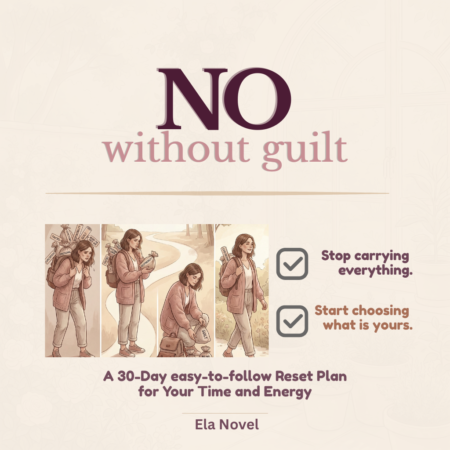
If this resonated, if you recognised the carrying and the waiting and the quiet longing to be seen and supported, NO Without Guilt is a calm, practical 30-day reset designed to help you begin changing the arrangement.
Not through confrontation or ultimatums. Through small, consistent daily shifts that gradually move the load from yours alone to genuinely shared.
Through short daily reflections and simple actions, it helps you:
✓ Identify what you carry by default without ever formally agreeing to it
✓ Create the pause before the automatic doing and absorbing
✓ Find clear, warm ways to ask for what you need without creating defensiveness
✓ Release the belief that being supported is something you have to earn
✓ Build a new normal where sharing the load is simply how love works
Sharing the load is not too much to ask. It never was. Start now.
Ela’s Love Life Stories is a space for women 40+ who are ready to reclaim their time, their energy, and themselves — not loudly, not dramatically, but quietly and consistently, one small shift at a time.
If this felt true to you — share it with a woman who needed to read it today.