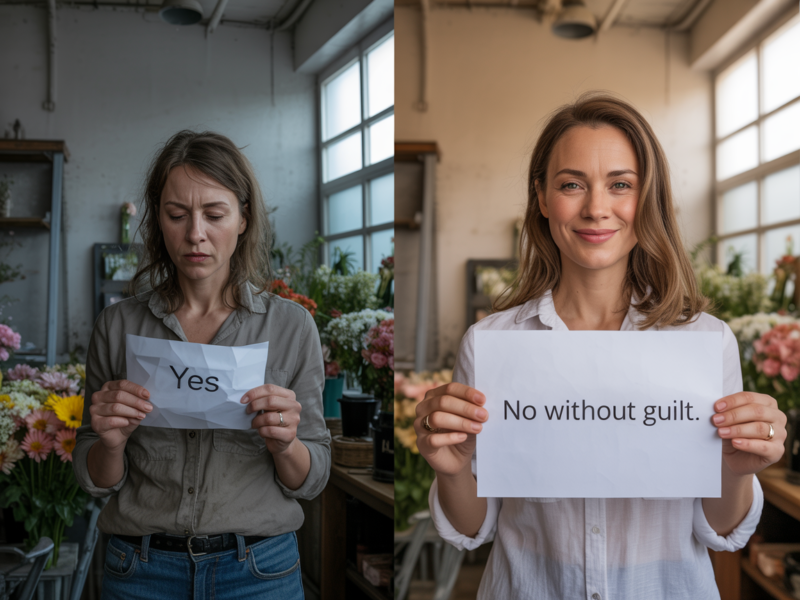
Which woman do you recognise yourself in right now?
You did not apply for the role of permanent host. It just became yours. And the cost of always hosting is higher than anyone around you realises. Here is how to stop always hosting and start showing up as a guest in your own life now.
Women who stop always hosting do not stop being generous. They stop being available by assumption. This post shows you exactly how to make that shift without disappointing the people you love.
You Did Not Apply for This Role. It Just Became Yours.
Nobody called a meeting. Nobody took a vote.
It simply happened. One family gathering at a time. One holiday at a time. One birthday that needed a table long enough to seat twenty and someone who knew who could not sit next to whom and who would not eat fish.
And that someone was always you.
Because your food is amazing. Because your home is warm. Because you have a particular gift for making people feel welcome the moment they walk through your door.
And because you are good at it, genuinely and naturally good at it, nobody ever thought to question whether you actually wanted to keep doing it.
Not your family. Not your friends. And if you are being completely honest with yourself, not even you.
Until now.
How Being Good at It Became a Trap
It started as a compliment. It always does.
Your cooking is incredible. Everyone loves coming to yours. You just have a way of making it feel special.
You accepted those words graciously because they were true and because they felt good and because there was a time, maybe there still is, when hosting genuinely brought you joy.
But somewhere along the way something shifted.
The compliment quietly became an assumption. The assumption quietly became an expectation. The expectation quietly became a fixed part of how your family and friends organise their lives.
She will host Christmas. She always does. The birthday dinner will be at hers. Where else would it be?
And you kept saying yes.
Not because you had the time. Not because you had the energy. Not because you sat down and thought: yes, I genuinely want to spend the next three days planning, shopping, cooking, cleaning and managing twenty people’s dietary requirements and emotional dynamics.
But because it felt easier than disappointing everyone. Because somewhere along the way you absorbed the belief that your love for the people in your life had to be demonstrated through your willingness to exhaust yourself for them.
So you said yes. Again. And again. And again.
Until one day you sat alone in your kitchen after the last guest had left, in the particular silence that follows a gathering you spent a week preparing for, and you made yourself a cup of tea.
The first thing you had made for yourself all day.
And you had a thought you had never quite let yourself finish before.
What Always Hosting Actually Costs You
Always hosting is not just about the cooking and the cleaning, though those alone are significant.
It is everything that surrounds them.
It is the mental load that begins days or weeks before anyone arrives. The planning, the logistics, the dietary restrictions remembered and accommodated, the seating arrangements considered, the timing of multiple dishes coordinated so everything is ready at once.
It is the emotional labour of managing twenty people in one room. The tensions noticed and quietly diffused. The conversations smoothed. The family dynamics navigated with the skill of someone who has been doing it for years.
It is the recovery time afterwards. The day or two of exhaustion that nobody sees because by the time it arrives the guests are gone and life has moved on and there is already another occasion being planned.
Research on the mental load of hosting and event planning consistently shows that women absorb the majority of invisible labour around family gatherings, including the planning, the logistics and the emotional management, without this work being acknowledged or redistributed.
And underneath all of it, the thing that costs the most and gets talked about the least, is your own absence from the moment you worked so hard to create.
While everyone else was present, relaxed, fed, gathered and enjoying themselves, you were managing. Orchestrating. Ensuring. You were the reason the moment existed. And you were the one person who never quite got to be inside it.
You created the experience for everyone else. And experienced very little of it yourself.
5 Signs Always Hosting Has Stopped Being a Choice
How do you know when something that once brought you joy has become an obligation you never actually agreed to? Here are five signs worth sitting with honestly.
1. You feel tired before it has even begun. The moment a gathering is mentioned, something in you already deflates. Not excitement. Not anticipation. Just the weight of knowing what is coming.
2. Nobody asks. They assume. There is no conversation about who will host. No discussion about whether this works for you. The assumption is simply made and the details begin to form around it. Your yes is taken rather than requested.
3. You spend more time managing than enjoying. During the gathering itself, you are rarely present. You are in the kitchen, or tracking what needs to happen next, or noticing the tension between two family members that nobody else has spotted yet.
4. You feel resentful and then guilty for feeling resentful. Somewhere underneath the warmth and the welcome there is a quiet frustration. A sense that the effort is not equal. And then, because you love these people and because the gathering is full of real joy, you feel guilty for feeling resentful at all.
5. The thought of saying no fills you with more dread than the hosting itself. Not because you want to host. But because disappointing everyone, disrupting the pattern, being the reason the gathering does not happen, feels worse than simply absorbing the cost one more time.
If any of these feel familiar, you are not being ungrateful or difficult or unloving. You are simply someone who has been giving more than her share for longer than is sustainable.
What You Are Actually Allowed to Do
Here is what nobody says clearly enough, so I want to say it directly.
You are allowed to enjoy the moment too. Not just create it for everyone else.
You are allowed to sit at the table you set and actually be present at it. To eat the food you cooked while it is still warm. To be a guest at your own gathering occasionally.
You are allowed to say: not this time, but I would love to come. You are allowed to say: I think it is someone else’s turn. You are allowed to say: I am happy to bring something, but I cannot host this one.
These are not failures of love. They are not withdrawals of warmth. They are not signs that you care less about your family or your friendships.
They are signs that you have begun to include yourself in the equation.
You do not have to prove your love by exhausting yourself. Love that requires your depletion is not a sustainable arrangement. And the people who genuinely love you, once they understand what always hosting has been costing you, will not want it at that price.
How to Stop Always Hosting — Gently and Without Drama
You do not need to announce a dramatic policy change. You do not need a difficult conversation or a family meeting. You need one small, honest shift at a time.
Say not this time instead of never again. The goal is not to stop hosting forever. It is to stop hosting automatically. Not this time is a complete sentence that changes nothing permanently but creates immediate space.
Let someone else step into the gap. When you do not volunteer, someone else often will. Not always immediately. There may be a moment of awkward silence while everyone waits for you to say yes as usual. Let the silence sit. See what happens.
Separate your love from your labour. Your presence at a gathering, your warmth, your conversation, your genuine enjoyment of being with the people you love, is a gift. It does not require a three-day production to be valuable.
Two More Steps That Change the Dynamic
Notice how it feels to receive instead of give. The next time someone else hosts, pay attention to what it feels like to arrive at someone else’s table. To be fed rather than to feed. To be a guest rather than the orchestrator. That feeling is something you deserve too.
Remember that sustainable love serves everyone better. A rested, present, genuinely willing version of you, showing up occasionally and by choice, gives more than an exhausted, resentful version showing up out of obligation every single time.
The Quiet Shift That Changes Everything
You are not being asked to stop being the warm, generous, wonderful host that you are.
You are being asked to make it a choice rather than a given.
To host when you want to. To pass when you need to. To trust that your relationships are strong enough to survive a renegotiation of the arrangements.
The people who love you will adjust. The gatherings will still happen. The food will still be wonderful, because you will be making it from a place of genuine choice rather than quiet obligation.
And you will finally be present at the table you set. Not just creating the moment for everyone else. Actually inside it.
Your Next Step — 30 Days to Stop Always Hosting
If this resonated, if you recognised the exhaustion of being the permanent host and the quiet longing to simply show up as a guest for once, NO Without Guilt is a calm, practical 30-day reset designed to help you make this shift.
Not by stopping being generous. By making your generosity a genuine choice rather than an automatic obligation.
Through short daily reflections and simple actions, it helps you:
✓ Recognise the hosting role you took on without formally agreeing to it
✓ Create space before the automatic yes to the next assumed gathering
✓ Find warm, clear ways to step back without disappointing the people you love
✓ Release the belief that your love has to be proved through exhaustion
✓ Build a new normal where you show up as a guest sometimes, not just the host
You do not have to prove your love by exhausting yourself. Start now.
Ela’s Love Life Stories is a space for women 40+ who are ready to reclaim their time, their energy, and themselves — not loudly, not dramatically, but quietly and consistently, one small shift at a time.
If this post felt true to you — share it with a woman who needed to read it today.