When did talking to people start feeling like work? If your conversations drain more than they fill, this post is for you. Here is how to protect your presence and find connection that actually goes both ways starting now.
Women who protect their presence do not stop caring. They stop being available by default. This post shows you exactly how to make that shift without losing the people who matter.
Can You Remember the Last Conversation That Left You Feeling Full?
Not drained. Not heavy. Not quietly rehearsing what you should have said differently or how you are going to fix what you just heard.
Full.
The way a conversation used to feel. Easy, reciprocal, warm. When talking to someone left you with more energy than you started with rather than less.
Can you remember the last time that happened?
Not a favour dressed up as a catch-up. Not an hour of venting that circled the same story for the fourth time this month with no movement and no resolution. Not a conversation where your role was to listen, absorb, advise and reassure, and receive nothing in return except the knowledge that you showed up again.
A real conversation. Where you were present without carrying anything extra.
If you are struggling to remember, this post is for you.
How You Became the Person Everyone Comes To
It did not happen overnight.
You did not wake up one day and decide to become the emotional centre of your social world. The person your friends call when something goes wrong. The one your family leans on when things get heavy. The colleague everyone gravitates toward when they need to process something difficult.
It accumulated. Quietly. Over years.
Because you are warm. Because you listen well. Because you have a particular quality, the ability to make people feel genuinely heard, that is rarer than most people realise and more valuable than most people acknowledge.
And because you are good at it, people kept coming. To vent. To ask. To lean. To unload.
You kept showing up. Because you care. Because it felt good at first to be needed and trusted and chosen. Because saying no to someone in pain felt unkind in a way you were not willing to be.
So you became the person. The one who is always available. Always steady. Always able to hold whatever someone else needs to put down for a moment.
Until you started to notice what it was costing you.
The Hidden Weight of Being Everyone’s Safe Place
There is a particular kind of exhaustion that comes from being the person everyone comes to. It is different from ordinary tiredness.
It is not the exhaustion of physical work or a demanding schedule. It is something quieter and more persistent.
It is the exhaustion of constant emotional output with very little input.
Of giving your full attention, your genuine care, your thoughtful responses, over and over again, to people who rarely think to ask how you are doing in return. Not because they are unkind. But because you have been so reliably present for so long that the idea of you needing something has simply never occurred to them.
You trained the people around you, unintentionally and gradually, to see you as a resource rather than a person. Someone to come to. Not someone to come alongside.
Research on emotional labour and burnout in women consistently shows that women who provide consistent emotional support without receiving it in return are significantly more likely to experience social burnout and relationship fatigue.
And somewhere in all of that showing up, something shifted.
Conversations stopped feeling like connection. They started feeling like work.
Your phone buzzing started producing a small, involuntary sense of dread. What does someone need now? Rather than the warmth of genuine anticipation.
Time with certain people stopped feeling restorative. It started feeling like something to recover from.
And you started to notice, with a quiet guilt you did not know what to do with, that you were beginning to protect your energy from the very people you love.
Not because you love them less. But because there is simply nothing left to give.
Caring and Being Constantly Available Are Not the Same Thing
Here is the distinction that changes everything. And the one most women have never been given permission to make clearly.
Caring about someone and being constantly available to them are not the same thing.
You can love someone deeply and still not answer every call immediately. You can be a good friend and still redirect a conversation that has circled the same complaint for the sixth time. You can be a devoted family member and still protect an evening that is genuinely yours.
Care does not require constant access to your time and energy. It never did.
What care requires is genuine presence when you choose to be present. Real attention when you have it to give. Honest connection, which is only possible when you are not running on empty.
A rested, boundaried, genuinely willing version of you gives infinitely more than a depleted version showing up out of obligation.
The people who truly love you deserve the first version. So do you.
5 Signs Your Conversations Have Become One-Sided
How do you know when caring has quietly become carrying? Here are five signs worth sitting with honestly.
1. You know everything about everyone’s problems and nobody knows much about yours. The information flows in one direction. You are the repository of everyone else’s struggles. Your own rarely get airtime because there never seems to be space, or because you have learned not to expect it.
2. Certain names on your phone produce a feeling of dread. Before you even answer, you already know roughly what is coming. Another problem. Another story. Another need. Your nervous system braces before the conversation even begins.
3. You leave interactions feeling worse than when you arrived. Not occasionally. Consistently. The conversation is over and you feel heavier, more tired, slightly depleted. What was supposed to be connection has become something you need to recover from.
4. You rehearse conversations before they happen. You prepare yourself. You think about what they might say and how you will manage it. You plan your exits. This is not what connection is supposed to feel like.
5. You cancel plans to protect your energy. Not because you do not care about the person. But because you cannot face another conversation that costs you more than it gives. And then you feel guilty for cancelling. And the cycle continues.
If you recognised yourself in more than one of these, you are not being selfish or antisocial. You are someone whose generosity has been running without boundaries for too long.
What It Looks Like When You Protect Your Presence
There is a version of your social life that does not exhaust you.
Not a version without people. You are someone who loves connection and always will be. A version where the connection is mutual. Where conversations go in both directions. Where your presence is chosen freely rather than given automatically out of habit or guilt.
In this version you answer calls when you genuinely want to, not out of obligation. You sit with a friend over coffee and leave feeling warm and full rather than drained. You redirect conversations that have become circular, gently and without guilt, because you have learned that absorbing the same story indefinitely helps nobody.
You have evenings that are genuinely yours. Mornings that belong to you. Pockets of time where nobody needs anything and you exist simply as yourself.
Your presence feels light again. Not because you care less. But because you have finally included yourself in the equation.
How to Start Protecting Your Presence Without Losing Your People
You do not need dramatic announcements or difficult declarations. The shift begins much more quietly.
Let calls go to voicemail sometimes. You are allowed to call back when you are ready rather than immediately. The small boundary of choosing when you engage, rather than being always available, begins to reset an expectation that has been in place for too long.
Redirect circular conversations gently. When someone returns to the same story for the fourth time without moving forward, you are allowed to say warmly: “I wonder if talking to someone professional might help with this.” You are not abandoning them. You are being honest about the limits of what conversation can do.
Ask to be asked. In conversations where you are always the listener, try introducing yourself. “Actually, can I tell you something that has been on my mind?” Some people simply need the invitation. Others will reveal, in their response, that the relationship was never as reciprocal as you hoped.
Two More Ways to Protect Your Presence
Notice how you feel after. Start paying attention to which interactions leave you fuller and which leave you emptier. This is not a verdict on the relationship. It is data. It will help you understand where your energy is going and whether it is being matched.
Protect one conversation a week that is entirely for you. A call with someone who asks how you are and genuinely waits for the answer. A coffee with someone whose company leaves you feeling better than before. One interaction a week that fills rather than drains. Start there.
Your Presence Is Not a Resource. It Is a Gift.
And gifts, real ones, are given freely, by choice, from a place of genuine abundance. Not automatically. Not endlessly. Not at the cost of the person doing the giving.
When you begin to treat your presence as something valuable, something that deserves to be offered rather than taken, something changes.
Not in the people around you. Not immediately. In you.
You begin to show up differently. More present when you are there. More honest about when you cannot be. More willing to receive as well as give.
And the conversations, the real ones, with the people who are capable of real ones, become something to look forward to again.
Not something to recover from.
Your Next Step — 30 Days to Lighter Presence
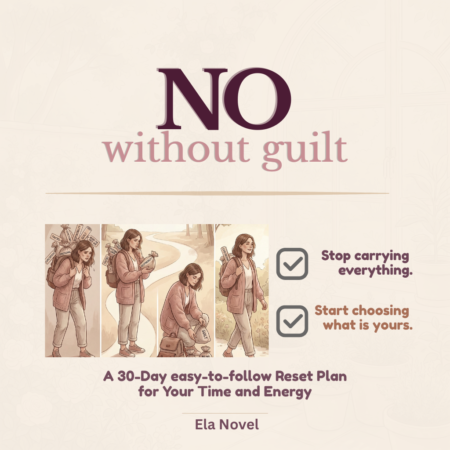
If this resonated, if you recognised the exhaustion of being everyone’s person and the quiet longing for something more reciprocal, NO Without Guilt is a calm, practical 30-day reset designed to help you make this shift gently and consistently.
Not to make you less caring. But to help you become more intentional about where your care goes and to protect enough of it for yourself.
Through short daily reflections and simple actions, it helps you:
✓ Recognise the patterns that keep you constantly available
✓ Create gentle limits on what you absorb and how often
✓ Redirect relationships toward genuine reciprocity
✓ Protect your time and energy without guilt or confrontation
✓ Rediscover what it feels like when your presence is truly yours
You keep your warmth. You finally keep some of it for yourself. Start now.
Ela’s Love Life Stories is a space for women 40+ who are ready to reclaim their time, their energy, and themselves — not loudly, not dramatically, but quietly and consistently, one small shift at a time.
If this post felt true to you — share it with a woman who needed to read it today.